May
Beginner, Beginner's Guide to Growing Marijuana, How To Grow Marijuana Seeds
Topping Cannabis Plants: Topped vs Non-Topped Guide (2026)
Topped vs Non-Topped? As avid cannabis plant growers, we’re regularly looking for ways to increase and improve our plants’ yields and health. Fortunately, cultivation techniques like plant training can achieve these goals. Cannabis plant training involves methods that control and manipulate the growth and shape of cannabis plants.
These methods can include Low-Stress Training (LST), which involves bending the plants and tying them into new positions, and High-Stress Training (HST), such as pruning and topping. Pruning and topping both require removing parts of the plants, which helps shape them, optimize the available light, and produce more colas or flowering sites.
Whether we grow outdoor or indoor plants, these straightforward techniques can help us:
- Optimize our growing space
- Boost our plants’ performance by producing more significant and better yields
- Grow healthier, longer-lasting plants
This article explains the differences between topping and pruning, the benefits of these plant training techniques and some tips on doing both well.
Topped vs Non-Topped Cannabis Plants. What’s the Difference?
Before we learn more about topping and pruning, let’s clear up a common question among growers — What’s the difference between topped vs non-topped cannabis plants?
Topped Cannabis Plants

As the question implies, the difference between topped vs non-topped cannabis plants is that topped plants have had the top of the central stalk, and sometimes secondary colas, removed. We do this to indoor and outdoor plants for several reasons, but it ultimately reshapes our plants for higher and better yields.
Non-Topped Cannabis Plants
Non-topped cannabis plants, or those left to grow naturally, typically form into a Christmas tree shape with one dominant, main stalk — or central cola — and multiple side branches. If the plant is outdoors, each of the various areas of the plant will receive some sunlight during different stages in the day as the sun travels across the sky. However, the lower branches will typically be shaded by the taller ones and receive less light overall.
Even more problematic regarding lighting is indoor cannabis plants that typically receive light from a grow lamp that is stationary and positioned directly above them at all times. The nature of this light source means that a naturally shaped or non-topped cannabis plant grown indoors will receive inefficient light overall as the lower branches and stalks won’t be exposed to it evenly.
Topping our cannabis plants can alleviate this and many more potential issues.
What Is Topping?
Topping is a plant training technique that overcomes lighting inefficiency for indoor and outdoor plants and is the method of choice for growers who want to increase their yields. It is also used by growers who want to optimize their growing space with just a few plants rather than using the Sea of Green (SOG) method, which involves squeezing in as many plants as possible.
Topping is used by cannabis growers during the growing cycle and involves cutting off the top part of the plants’ central stalks to arrest their vertical growth. This training technique promotes the development of two new main stalks, or colas, and the growth of the lower secondary branches.
Want to know more about how to top and marijuana plant?
The Benefits of Topping
The benefits of topping cannabis plants are plentiful. The reshaping that comes from topping allows our plants’ smaller side branches to gain more light exposure. Topping has also been shown to alter biological processes such as photosynthesis and nitrogen, carbon and secondary metabolism, helping to ensure our plants’ health and a quality yield.
Here are some additional benefits:
- Promotes bushier plants with an increased number of buds
- Enables even light distribution for larger buds
- Optimizes limited growing space
- Stimulates healthier plants
Are There Any Down-Sides to Topping?
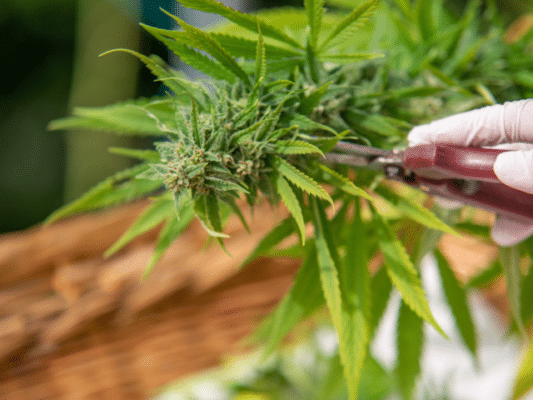
Removing a healthy part of the plant can seem counter-intuitive and a little intimidating for beginners. Nerves or lack of correct information can lead to the following down-sides to topping:
- An inexact cut at the plant’s node can cause irreversible stress and promote disease
- Inexperienced growers can top too soon or too late, causing undue stress to the plants
How to Top Like a Pro
Since topping does cause stress to our cannabis plants, it’s essential we know what we’re doing before we begin. We also need to ensure our plants are strong and healthy and at the right stage to withstand any stress caused by the topping.
Here are some tips for topping like a pro.
- Sterilize and sharpen a scalpel or pair of scissors. Topping your plant with a blunt tool can break the stem and leave a larger wound than intended.
- For the first topping, cut the top of the plant off above the 4th or 5th node in one clean cut. Make sure to leave about 5 mm of space between where you cut and the lateral branches to give you a little bit of room for error.
- For subsequent toppings of the same plant, cut each side branch above the second or third node.
- Monitor the plants for signs of stress and adjust care accordingly.
The placement of the toppings will determine the eventual shape of our plants. For example, the first cut should be high enough to leave enough side branches for the plant to bush out properly. The subsequent cuts should allow the plant to continue to bush out, and where we make them depends on how bushy and big we want the final plant to be.
When Should Topping Be Done?
Topping can be done once our plants have developed anywhere between four and six nodes. This vegetative growth stage indicates our plant’s roots and stems will be strong enough to recover.
Counting Nodes
A plant’s stem is made up of nodes and internodes. Nodes are areas on the stems from which branches and leaves grow, while internodes are the intervals on the stems between the nodes. Locating the nodes of a plant is crucial when you are doing regular maintenance, such as topping and pruning.
Our plants should generally reach the topping stage after approximately 30 days of development. However, different plant varieties grow at different speeds, so we always have to consider this.
Don’t top cannabis plants during the seedling stage. Topping during the seedling stage causes too much stress to our plants and risks stunting their growth or killing them altogether.
Don’t top plants during the flowing stage. Topping plants during the flowering stage will waste the plant’s resources it has already spent on growing the colas and buds, ultimately reducing their yield.
Wait for at least one to two weeks before topping any new growth to give the plants ample recovery time from the stress of adjusting to new growth patterns.
What Is Pruning?
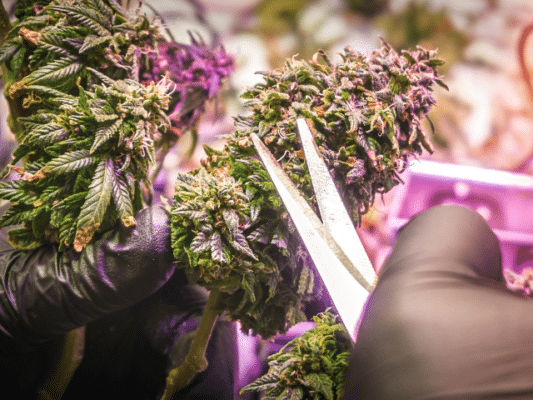
Pruning involves selectively removing plant branches and leaves that are dead or won’t receive enough light to grow to their full potential. If these dead plant parts are left to fall off in due time, the plant will waste resources trying to keep them alive. Instead, a pruned plant will be able to optimize its resources to grow strong. Also, produce a more significant number of high-quality, healthy buds.
The Pros of Pruning
Pruning cannabis plants allows them to focus their energies on producing buds in healthy areas. Pruning also results in the following benefits:
- Increases the amount of light the healthy parts of the plants receive
- Reduces pests and diseases by removing infested and infected leaves and branches
- Improves airflow, inhibiting the growth of mould
Pruning Risks
Although pruning cannabis plants is a pretty straightforward training technique, it isn’t without its risks, including the following:
- Over-pruning can reduce the plant’s ability to grow and lead to reduced yields.
- Partial pruning can leave the plant vulnerable to the spreading of disease.
- Pruning at the wrong time, for example, in the flowering stage, can encourage new growth when the plant should be focusing resources on creating buds, reducing the overall yield.
Proper Pruning Procedures
The best time to prune cannabis plants is once they begin to take a bushy shape, which should be in their early stages of growth.
Here are some steps to proper pruning.
- Use sharp and clean pruning shears.
- Snip off large branches near the bottom of the plant first to provide some space for the more detailed work.
- Remove all branches that won’t receive enough light, such as those in the plant’s middle.
- Prune all small or dying leaves and branches.
Pruning or Topping or Both?
Pruning and topping cannabis plants are both plant training methods used by cannabis growers to help ensure their plants’ health and robust yield. They can be applied to both indoor and outdoor-grown cannabis plants in equal measure and with similar results.
Although plant training may seem daunting, with the proper knowledge, anyone can manage it. And with so many benefits, learning these techniques is worth the effort.
Quick Reference: Topping at a Glance
- Best topping window: node 3 to node 5, once the plant has 5-6 sets of true fan leaves
- Recovery time after a topping cut: 3-5 days before new growth resumes at the split
- Minimum recommended veg time after topping before flipping to 12/12: 2-3 weeks
- Topping removes 100% of the apical meristem; FIM removes roughly 70-80% of the new growth tip, leaving a smaller remnant that can produce 4+ colas from one cut
- LST (low-stress training) bends and ties stems instead of cutting, with zero recovery downtime
- Double-topped plants commonly finish with 4 main colas; triple-topped plants can push 6-8, but each added round tacks on 1-2 weeks of veg
Frequently Asked Questions
When is the best time to top a cannabis plant?
Wait until the plant has established at least 3 to 5 nodes of true leaves (not the first round cotyledon leaves). Topping too early, before the root system is established, slows the plant more than it should. Most growers make the first cut just above the 5th or 6th node.
Do topped plants really yield more than non-topped plants?
Topped plants trade one dominant cola for two (or more) co-dominant colas, which spreads bud sites more evenly across the canopy. The yield gain only shows up if you give the plant enough veg time afterward, typically 2-3 weeks minimum, so the new colas can catch up in size before flowering starts.
How many times can you top a cannabis plant?
There’s no hard limit, but each topping event adds recovery and veg time. Two rounds of topping (producing 4 main colas) is the most common approach for home growers balancing yield against a longer vegetative stage. Three or more rounds work best under longer indoor veg schedules where time isn’t a constraint.
Should beginners top or just use LST?
LST is lower risk since there’s no open wound and no recovery lag, making it a good starting point. Topping gives a stronger multi-cola structure but requires confident timing and a bit of stress tolerance from the plant.